Picture a regular classroom on a regular day. The teacher hands out a worksheet, and within ten minutes, one child has already submitted it and is sitting back with a satisfied smile. Another child is still working through the third question, rereading it, crossing out an answer, trying again. Most of us would instinctively assume the first child is the “smarter” one.
But does that really tell us how well a child is learning?
At Sanskruti World School in Boisar, we see this happen every single day and this is a question worth sitting with, because so much of how we judge learning in schools comes down to speed. Who put their hand up first. Who finished the chapter fastest. Who completed the homework before anyone else got started. Somewhere along the way, we started treating speed as a stand-in for understanding. The truth is a little more layered than that, and it matters for how we support our children.
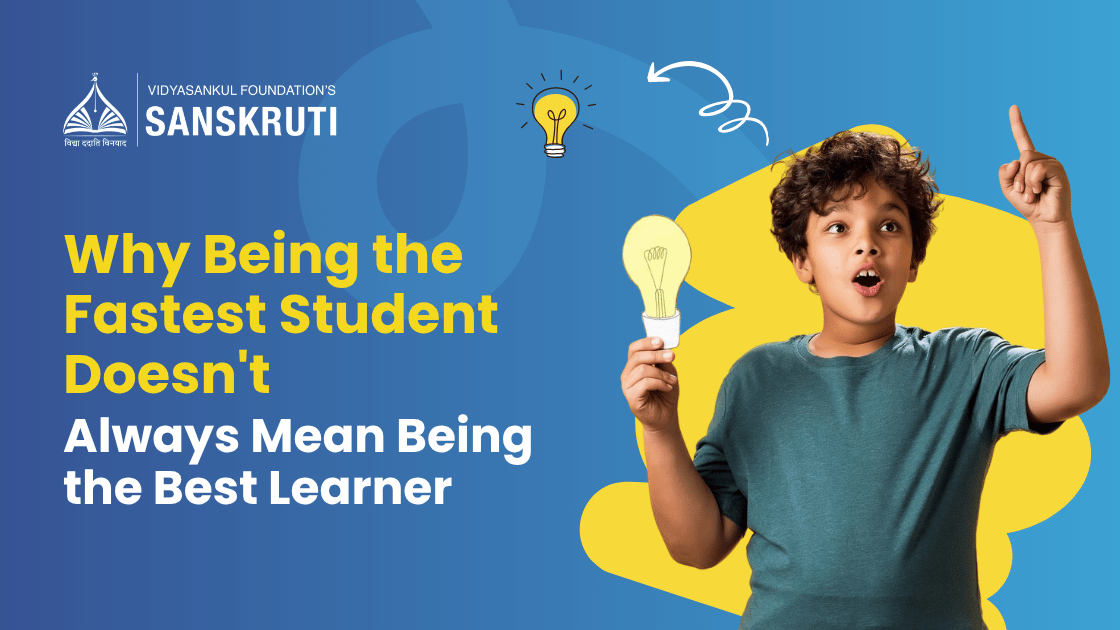
Is the Fastest Student Always the Best Learner?
Not always, and that is worth saying plainly. Speed can be useful, but it is not the same thing as understanding.
A child who finishes quickly may genuinely have grasped the concept well. But speed can also hide gaps. Some children learn to quickly memorize a formula or a definition without really knowing what it means or when to use it. Others rush through questions, skip a step, and make mistakes they would have caught with a little more care. A child can even do well in a timed test and then freeze when the same concept shows up in a slightly different, unfamiliar way.
On the other hand, a child who takes longer is often doing something quite valuable. They may be reading the question twice to be sure or may be improving their reading skills. They may be pausing to connect it with something they already know. They may be double checking their own reasoning before committing to an answer. That kind of thinking takes time, and time is not the enemy here.
Fast Learner vs Slow Learner: What’s the Real Difference?
The real difference in fast learner vs slow learner is not ability, it is process. Children simply take in and work through information differently.
Some children pick up a new math formula the moment it is explained. Others need to see it applied to two or three examples, or need a diagram, before it clicks. Neither approach says anything about how capable the child is. It is easy to assume that quicker means smarter, but that is not what classroom experience shows us. The label “slow learner” is often used carelessly, and it can be unfair and even a little hurtful. A more useful question to ask is not “who finished first”, but “who actually understood what they were doing”.
Why Learning at Your Own Pace Matters
Learning at your own pace simply means being given enough time and support to genuinely understand a concept, rather than being rushed through it.
Here is the thing: when children feel constantly compared to how fast their classmates are working, it creates pressure that has nothing to do with the subject itself. A child under that kind of pressure may start guessing instead of thinking, or may stop asking questions out of fear that it makes them look behind.
This does not mean lowering expectations or ignoring deadlines. It means recognizing that two children can reach the same level of understanding through different routes and at different speeds, and both routes are valid.
What Learning Skills for Students Really Look Like
Strong learning skills for students go well beyond finishing work quickly and holistic education plays an important role in it. They show up in how a child engages with a problem, not just how fast they get through it. Some of these skills are easy to spot, others are quieter and easy to miss if you are only looking at the final answer.
A child who is genuinely building strong learning skills tends to:
- Ask meaningful questions instead of staying quiet when something is unclear
- Listen carefully rather than rushing to respond
- Work through a problem rather than guess at it
- Explain an idea in their own words, not just repeat what they heard
- Notice a mistake and figure out where it went wrong
- Make connections between subjects and ideas
- Stay curious even after the “right answer” has been found
- Feel comfortable working independently
This is also where the importance of critical thinking in students comes in. Real learning is not about remembering information, it is about questioning and using it. A child who asks “why does this happen” or “is there another way to solve this” is actively engaging with the material, not simply moving through it.
That kind of thinking cannot be rushed. It needs room: time to compare ideas, time to be wrong, time to discuss and reconsider before arriving at a conclusion that actually makes sense to them.
Learning Is Not a Race To Be Won
The child who finishes first is not necessarily the child who has learned the most, and the child who takes their time is not falling behind. Real learning happens when a child has the space to understand, ask questions, practise, reflect, and grow at a pace that genuinely works for them.
At Sanskruti World School, Boisar, this belief shapes how we think about every child in our classrooms. We know that no two children learn in exactly the same way, and we try to notice and respect that difference rather than smooth it over. Our focus stays on each child’s individual progress, adjusting pace and support where needed, so that every student has the chance to build real confidence, understand concepts deeply, and develop learning habits that will carry them well beyond the classroom, ultimately helping them excel in a way that is genuinely their own.
If you wish to give your child a learning away from pace judgement, we are always here!