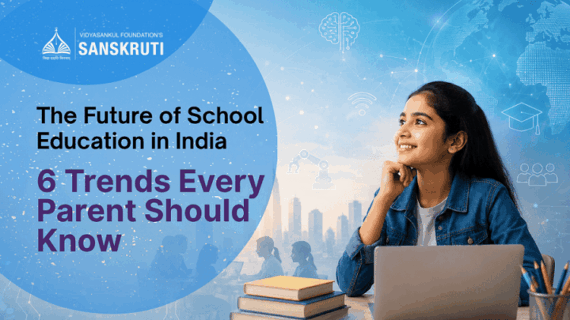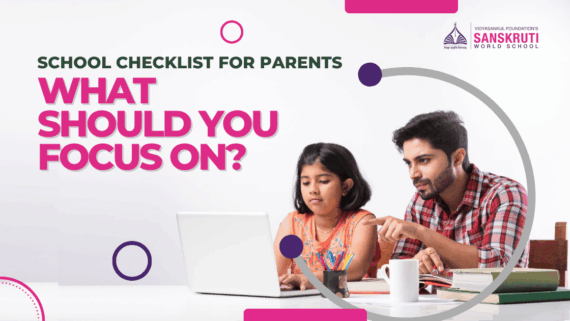
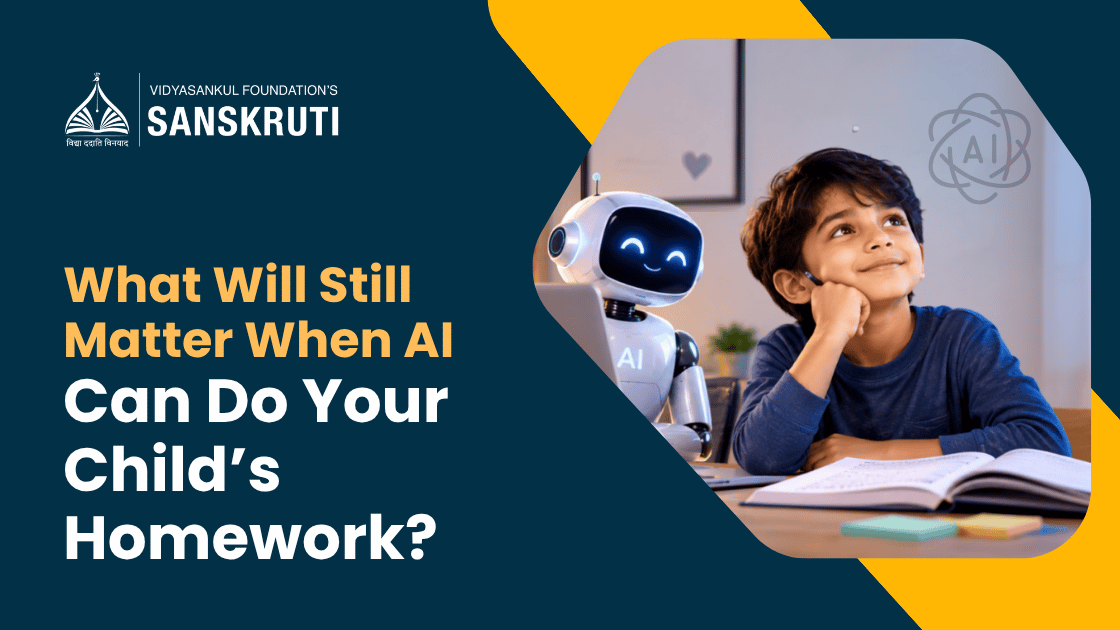
It happens in almost every home now. Your child is stuck on a maths problem, or needs help writing a paragraph, and within seconds, an AI tool gives a clear, correct answer. No struggle, no waiting for a tuition class, no flipping through a textbook. Just an answer, ready to copy.
Many parents wonder the same thing: if a machine can solve the problem, explain the concept, and even write the essay, what exactly is school supposed to teach anymore?
At Sanskruti World School in Boisar, we understand that AI is changing the way students learn. Here is the real question worth sitting with. If AI for students can answer almost anything instantly, what should education focus on instead? The answer is not about banning technology or pretending it does not exist. It is about understanding that the value of education has never really been about producing correct answers. It is about what a child learns while getting there.
When Getting the Answer Is No Longer the Hard Part
For decades, a lot of schooling revolved around finding information: memorising facts, solving standard problems, writing answers in a particular format. AI has quietly changed that. Information and answers are now available in seconds, often explained clearly and patiently.
When access to answers stops being the hard part, the real learning shifts elsewhere. Knowing an answer is not the same as understanding it. A child who copies a solution has completed a task. A child who understands why that solution works can apply it to a new problem, explain it to someone else, and notice when something does not add up.
This is the shift schools need to prepare for. AI in education is not the enemy of learning, but it does mean that memorization alone can no longer be the main goal.
What Children Still Need to Learn in an AI World
Think about it. AI can generate a paragraph, but it cannot feel curious about why volcanoes erupt or why a friend is upset. It can suggest a solution, but it cannot decide, on its own, whether that solution is the right one for a particular situation.
Certain human abilities still need real experience to grow:
- Curiosity that pushes a child to ask “why” even when no one is asking them to.
- Independent thinking, so they form their own view instead of accepting the first answer they see.
- Creativity, which comes from connecting ideas in ways a tool was never asked to.
- Empathy and communication, which grow through real conversations, group work, and disagreements handled respectfully.
- Decision-making, built through practice, mistakes, and reflection, not through a generated response.
Naturally, problem solving and critical thinking skills for students for students sit at the centre of this. These are not taught through a single lesson. They develop gradually, through questions asked in class, projects attempted with peers, and problems that do not have one neat, google-able answer.
The Real Role of AI for Students
The point is not to keep children away from technology. What matters is what children learn to do with it. Used thoughtfully, AI for students can genuinely support learning rather than replace it.
For example, AI can help a child understand a concept explained in a different way, generate extra practice questions for revision, help brainstorm ideas before writing an essay, or offer a second approach to a maths problem so a child can compare methods.
What should remain the child’s own work is just as important: checking whether information is accurate, forming a personal opinion, attempting the problem before checking a shortcut, writing in their own words, and being able to explain, out loud, what they actually learned. That last step, explaining it themselves, is often where real learning becomes visible.
Top Skills That Will Matter in the Future
Nobody can predict every job or tool that will exist when today’s children grow up. But certain future skills for students consistently show up in every conversation about the future of education: communication, collaboration, creativity, adaptability, and sound decision-making.
These are often grouped under 21st century skills, and there is a simple reason they matter. Machines are good at speed and information. Humans remain better at judgement, context, and working with other people. A child who can think clearly, adapt to new situations, and collaborate well will always have an advantage, regardless of how advanced technology becomes.
What Future-Ready Education Really Means
Future-ready education is often misunderstood as simply adding more gadgets and apps to a classroom. That is not quite it. It means preparing children to use technology wisely while strengthening the human abilities technology cannot replicate.
In practice, this looks like more project-based learning, open discussions, hands-on activities, teamwork, and real-world problem solving, alongside strong academic foundations. It is less about replacing textbooks with screens, and more about changing what happens inside the classroom.
What Parents Should Look For in a School
When evaluating a school today, a few questions are worth asking. Does the school encourage children to ask questions, not just answer them? Is learning activity-based and experiential, rather than purely textbook-driven? Is technology used meaningfully, not as a substitute for teaching?
Also consider whether there are genuine opportunities for teamwork, communication, and building life skills for students. A supportive teacher-student relationship, encouragement of independent thinking, and a focus on preparing children for changing career paths all matter. Parents in the region often look for a well-rounded CBSE school in Boisar that balances academics with these broader capabilities.
The Goal Is Not to Beat AI; But Leverage It For Future Ready Skills
But there is something we should not overlook: children do not need to compete with AI at tasks AI already does quickly. That race cannot be won, and it is not worth running. What children need instead is the ability to think clearly, ask good questions, create original work, communicate with confidence, and make responsible choices, including responsible choices about how they use technology itself. This is a more meaningful goal, and a far more achievable one.
Preparing Children for a Future-Ready Life
At the end of the day, nobody can say with certainty which jobs or technologies will define the world our children will work in. Careers that do not exist today may shape their future, and tools that seem advanced right now may look quite basic a decade from now. What schools can control is how well they prepare children to adapt, think independently, solve problems, collaborate, and keep learning throughout their lives.
This is exactly why the conversation around AI in classrooms should not be about fear or resistance. It should be about intention: using technology where it genuinely helps, while making sure children still get plenty of opportunities to struggle a little, think for themselves, and grow through real experiences.
At Sanskruti World School, Boisar, this balance sits at the heart of how our students are taught. Strong academic foundations are built alongside curiosity, practical thinking, and the confidence to face situations that do not come with a ready-made answer. Our classrooms are designed to encourage questions as much as answers, so children learn to reason, reflect, and apply what they know rather than simply recall it. This approach gives them a steadier footing, whether they are facing a school exam today or an unfamiliar challenge many years from now.
If you are looking for a school that takes both learning and the future seriously, we would welcome the chance to show you what that looks like in our classrooms.
Give your child a future-ready education!