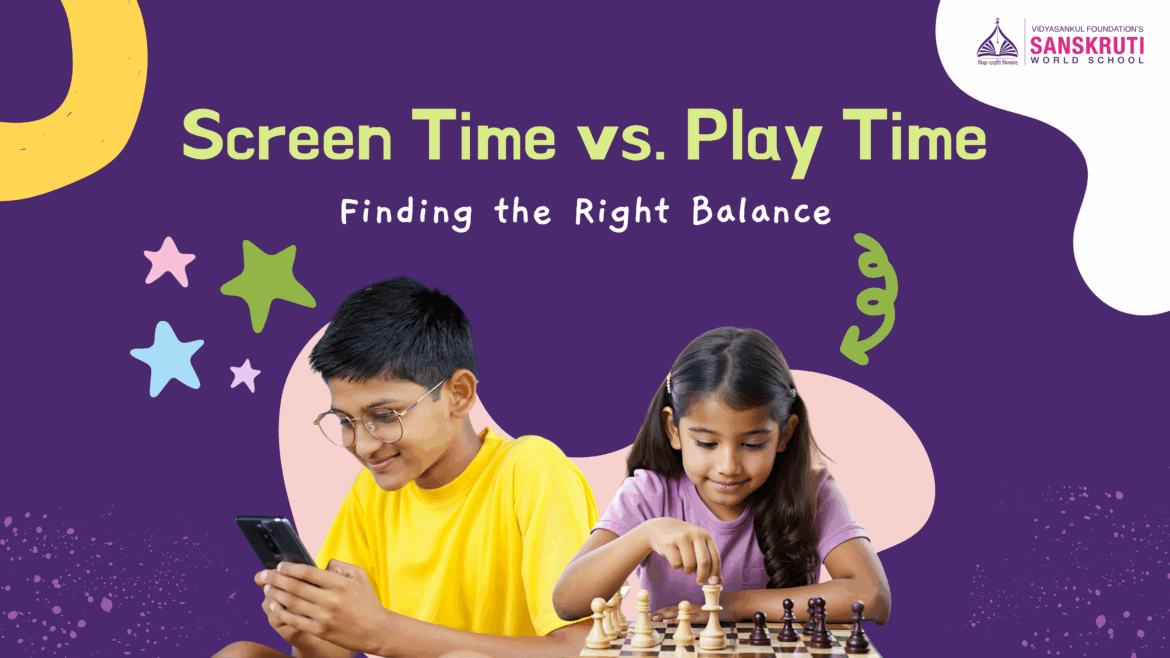
You might have noticed how quickly our children’s worlds have shifted. One moment, they’re glued to a bright tablet, fingers dancing across the screen. Next, they’re running in the playground, laughter echoing in the air. At Sanskruti World School, the best CBSE school in Palghar, we see this every day, and we understand the challenge of finding that delicate balance between screen time and play time.
In today’s rapidly evolving educational landscape, technology is more than just entertainment. It’s an essential part of learning. Yet, nothing can replace the benefits of play, the kind that sparks imagination, encourages social skills, and strengthens the body. So how can we help children enjoy the best of both worlds? Let’s explore.
Why Play Time Matters
Play is not just fun, it’s fundamental to a child’s growth. Whether it’s building a sandcastle, drawing a picture, or running through the park, play nurtures creativity, develops motor skills, and teaches children how to solve problems on their own.
We’ve seen firsthand how children blossom when given the space to explore. The play-based learning programs at our International School in Boisar campus allow kids to interact, collaborate, and learn by doing. The laughter, curiosity, and spontaneous discovery that happen during play are experiences that no screen can replicate.
Play also offers emotional benefits. It teaches patience, resilience, and teamwork. A child who plays regularly often demonstrates better communication skills and emotional intelligence. These are essential life skills that complement the academic foundation built in school.
The Role of Screen Time in Learning
On the other hand, screen time isn’t the enemy; it’s about how it’s used. Technology is increasingly integrated into classrooms worldwide, and at Sanskruti World School, we believe Artificial Intelligence in Education is all set to create personalized learning experiences. From interactive lessons to smart assessment tools, AI is now helping teachers understand each child’s learning style and pace, ensuring that no one falls behind.
Digital tools can make learning more engaging and interactive. For example, virtual science experiments or math games can turn complex concepts into fun challenges. But excessive screen use without guidance can lead to eye strain, reduced attention span, and even impact sleep patterns. That’s why setting limits and fostering mindful use of technology is key.
Finding the Right Balance
So, how do we find a healthy balance between screen time and play time? Here are a few practical tips we recommend to parents:
- Set clear boundaries: Decide on daily screen time limits based on your child’s age. Consistency helps children understand expectations.
- Encourage outdoor activity: Activities like cycling, sports, or even a simple walk can keep kids physically active and mentally refreshed.
- Mix learning and play: Educational apps or AI-powered games can be combined with hands-on activities to create a well-rounded learning experience.
- Family involvement: Play with your child. Board games, storytelling, or garden activities strengthen bonds and show that learning can happen everywhere.
- Observe and adapt: Every child is unique. Some may thrive with more hands-on play, while others may benefit from technology-assisted learning. Adjust routines accordingly.
In our experience, balancing academics with play ensures that children are not only intellectually capable but also socially and emotionally developed. By creating an environment where kids can enjoy both, we prepare them for a life of curiosity, resilience, and adaptability.
Sanskruti World School’s Approach
At our CBSE school in Palghar, we understand that every child is unique. Our classrooms are designed to integrate technology in a meaningful way, while our play areas encourage exploration and imagination. Teachers observe each child closely, guiding them to use screens constructively while never neglecting the benefits of active play.
For instance, our tech-based learning tools help children understand complex concepts with ease. At the same time, our playgrounds, activity zones, and creative classrooms offer a safe space for children to engage, experiment, and express themselves freely.
We believe that learning is not just about textbooks and grades, it’s about nurturing curiosity, fostering confidence, and creating joyful experiences. By balancing screen time and play time, we equip our students with skills that go beyond the classroom.
Encouraging Parents to Join the Journey
Finding the right balance is not only about setting rules, it’s about understanding your child’s needs and guiding them thoughtfully. At Sanskruti World School, we highly encourage parents to create routines that respect both technology and play. We motivate families to explore, experiment, and enjoy this journey together.
Remember, the goal isn’t to eliminate screen time or play, it’s to create harmony between the two. A child who enjoys active play and purposeful learning grows into a well-rounded individual, ready to face the challenges of tomorrow.
Final Thoughts
“Play gives children a chance to practice what they are learning.”
Balancing screen time and play time may seem tricky, but it’s entirely possible with awareness, consistency, and support. By blending technology with opportunities for creative and physical play, we can help children thrive both academically and personally.
At Sanskruti World School, our holistic approach ensures that your child experiences the best of both worlds, innovative learning and joyful, active play in our vibrant campus. Together, we can help children grow curious, confident, and balanced, ready to explore life with enthusiasm and joy, while building habits that last a lifetime.