Your child asks why the sky turns orange at sunset, or why the ice in their glass melts faster than the ice tray in the freezer. You probably answer quickly and move on with dinner. But that one question, and the way you respond to it, is doing more for your child’s mind than an entire worksheet.
School builds the foundation, but so much of a child’s intellectual growth happens in these ordinary, unplanned moments at home. At Sanskruti World School in Boisar, we tell parents this often: you are not just dropping your child off and picking them up. You’re shaping how they think, every single day, often without realising it. Let’s explore how parents can support child’s intellectual growth and understand the small, doable things that make a real difference, nothing fancy, just what actually works.
1. Create an Encouraging Home Environment
You don’t always need a study corner with charts and a globe (though if your child likes that, go for it). What matters more is simpler than that. When your child asks something, do they feel like it’s a good question, or an interruption? That reaction, over months and years, decides whether a child keeps asking or stops. If your child gets a math problem wrong but you can see they tried a clever way to solve it, say so. Praise the attempt before the answer.
Kids who are afraid of getting things wrong tend to play it safe. Kids who feel safe being wrong keep exploring, and that’s really the whole point of a good home learning environment. It’s good for intellectual growth of children.
2. Encourage Reading Books
If we had to pick one habit that does the most for a child’s thinking, it would be reading, hands down. It builds vocabulary without your child even noticing, it stretches imagination, and it trains a kind of patience and focus that’s hard to build any other way. Skip the reading lists for now. Let your child pick books about whatever they’re into, dinosaurs, cricket, ghost stories, doesn’t matter. Ten minutes before bed, done every night, beats an occasional Sunday afternoon marathon. The moment reading starts to feel like an assignment, most of the benefit disappears anyway, and it is extremely beneficial for child’s intellectual growth.
3. Be Open for Communication, Be Approachable
“How was school?” gets you “fine” almost every time. Try something else. Ask what was the most surprising thing they heard today, or whether anything made them laugh. Questions like that actually get an answer, and they push your child to think back over their day instead of just replying on autopilot, effectively boosting intellectual growth of children.
Tell them about your day too, and ask what they’d have done in your place. When they answer, even if the logic doesn’t quite hold up, hear them out before jumping in. That patience is what tells a child their opinions are worth having in the first place, which is where real critical thinking starts.
4. Let Them Find Answers
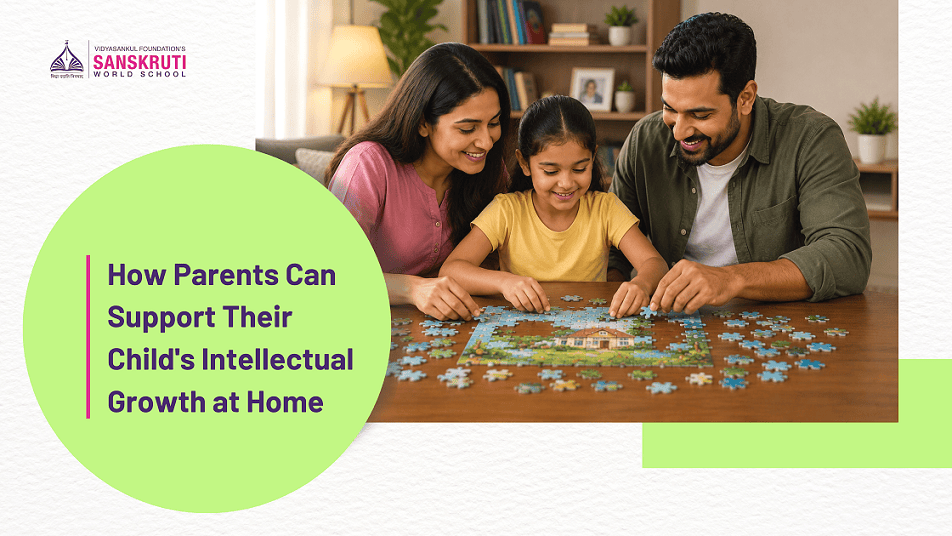
It’s tempting to solve every problem the second your child gets stuck. Resist that, at least sometimes. Let them sit with a puzzle for a few extra minutes before you step in. Let them choose which game to play or how to plan their evening, within reason for their age. The same goes for real situations, not just games. Can’t find the water bottle? Ask where they think it might be instead of finding it for them yourself. These tiny moments of figuring things out on their own build something that worksheets can’t, a child who actually trusts their own thinking.
5. Screens Aren’t the Enemy, Mindless Scrolling Is
Technology isn’t going anywhere, and there’s no point pretending your child won’t use it. The difference lies in how. An hour spent watching random reels does very little for a child’s mind. An hour spent on a good learning app, or a documentary about space, does quite a lot. Sit with your child sometimes while they’re on a screen. Ask what they found interesting afterward. Over time, this teaches them to see a screen as something you can learn from, not just something that entertains you. Encourage digital literacy in your child.
6. Involve Them in Everyday Activities
You don’t need to plan “learning activities” every weekend. Cooking together teaches measurement and a bit of chemistry without either of you calling it that. Taking your child grocery shopping means talking about prices, quantities, and why the bigger pack is sometimes cheaper.
A walk in the evening turns into a lesson the moment your child spots an odd looking leaf or asks about a bird’s call. Even something as small as watering the plants or helping set the table builds a sense of responsibility alongside a few practical skills. None of this takes extra time out of your day. It’s already there, you just have to notice it.
Learning Begins at Home and Grows for Life
You don’t need a perfect routine or a picture-perfect learning space to support your child’s growth. What truly matters is being present in the little moments. Listening to their questions, reading a story together, encouraging them to think for themselves, or simply having meaningful conversations each day can make a lasting difference.
These small, consistent efforts help nurture curious, confident, and independent learners over time.
As the best primary school in Boisar, we believe that the strongest foundation for a child’s intellectual growth is built when parents and teachers work together. That’s why we actively involve parents throughout their child’s learning journey, helping create meaningful learning experiences both at school and at home.
Together, we can inspire a love for learning, encourage independent thinking, and help your child grow into a confident individual who is ready for the future.
Your child isn’t a part of Sanskruti World School yet?
Let’s connect and discover how we can work together to nurture your child’s curiosity, confidence, and love for learning from the very beginning years of learning.
ADMISSIONS OPEN FOR THE NEW ACADEMIC SESSION