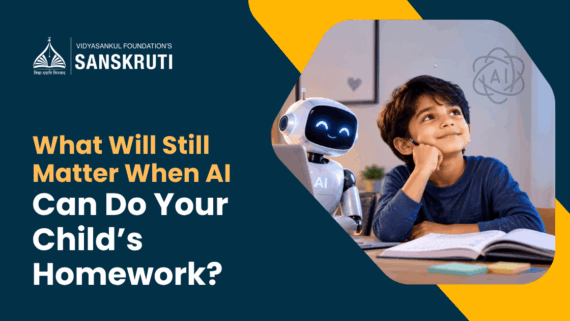

Think of a group of curious children gathered around a tablet, asking ChatGPT to solve their math problem or generate a fun story within seconds. What once seemed futuristic is now reality, AI is at their fingertips, changing what it means to learn and explore.
Artificial Intelligence is everywhere, influencing not only what we learn, but how we learn. Across the globe, classrooms are evolving rapidly. Teachers are blending tried-and-tested methods with powerful technologies to create more engaging, personalized, and effective learning journeys for every child. As we stand at this crossroads, the real question isn’t just, “What can AI do?” but “How is learning changing in the AI era?” This is a journey that Sanskruti World School & Junior College in Boisar is leading with vision and commitment. Let’s explore how AI is shaping the future of learning.
2. Why AI Matters in Education
Traditional learning often meant one-size-fits-all lessons, everyone moved at the same pace, regardless of their interests or strengths. But every child is unique. Some grasp concepts quickly, while others benefit from more time and support. This is where AI makes a remarkable difference.
Artificial intelligence can analyze how a student learns, where they excel, and where they face challenges. By tracking progress, AI tools can suggest personalized activities or extra practice, like a maths app that offers more puzzles when it spots a gap, or a digital reading platform that introduces new words just when a student is ready for them. Such tools can support diverse learning styles and abilities, and ensure nobody is left behind and everyone has the chance to shine.
3. How AI Can Help Students Learn
There’s a revolution underway in how lessons are delivered and experienced. Adaptive learning platforms powered by AI can modify content, giving advanced learners challenging problems while helping others solidify their understanding at their own unique pace.
For example, students in the english primary school in Boisar might use interactive software to reinforce grammar skills. AI isn’t just about drills and quizzes; it’s changing project-based learning too. Imagine a classroom where students brainstorm science fair ideas with ChatGPT, or use tools like Google Gemini to explore visual and interactive resources for their projects. AI can suggest research angles, provide instant feedback, and even help visualize complex topics with diagrams or simulations.
This level of support extends to everyone: students who need extra help can revisit topics until they master them, while those eager for more can dig deeper and explore tangents beyond the textbook. This adaptability fosters problem-solving and critical thinking because students aren’t just memorizing answers, they’re learning how to ask the right questions, investigate, and think creatively.
4. Building 21st-Century Skills with AI
Today’s world calls for much more than rote memory. Children must be able to think critically, collaborate, adapt quickly, and express new ideas creatively. AI is a powerful ally in this process. In many international schools in Palghar, students are use technology not only as a learning tool but as a springboard for exploration.
AI-powered platforms encourage young learners to brainstorm, test their theories in digital environments, and reflect on what they’ve learned. They can simulate real-world challenges, helping students practice decision-making and teamwork in a setting where mistakes are just new learning opportunities. Yet, real growth means pairing these experiences with strong basics: literacy, math, communication, and social-emotional skills. At Sanskruti World School, we understand that technology alone isn’t enough; it must be used to build on a firm educational foundation, one that balances innovation with core values and holistic growth.
5. The Human Side of Learning
Despite the excitement around AI, it’s important to remember that technology is a tool, never a replacement for human connection. The best learning happens when teachers blend digital support with genuine empathy, encouragement, and personal guidance.
At our school and junior college in Palghar, students receive one-on-one feedback, support, and motivation—a smile, a reassuring word, or a creative challenge that only a caring teacher can provide. AI helps identify opportunities and smooth out the path, but it’s the human touch that truly inspires confidence and curiosity.
6. Preparing for the Future
Students growing up today are not just preparing for exams; they’re preparing for a world that will keep changing, often in unexpected ways. By building familiarity and confidence with AI from an early age, learners become adaptable, curious, and resilient. These are the qualities that make them ready for higher studies and promising careers, whether in science, commerce, arts, or entirely new fields.
At our junior college in Boisar, students can choose science, commerce, or arts—each supported by modern laboratories, rich libraries, and a focus on lifelong skills like leadership, reflection, and teamwork. Our programs all aim to foster well-rounded individuals, ready for both academic and personal success.
Future-Ready Your Child with Exposure to AI
Artificial Intelligence is changing education for the better, making learning more personal, engaging, and future-ready. Instead of seeing AI as a challenge, families and schools can embrace it as an empowering tool—a companion on the lifelong journey of learning. At Sanskruti World School & Junior College, every child is encouraged to explore, question, and create with confidence. The future is bright for learners who are both tech-savvy and deeply human. Let’s give them the skills, support, and spirit to shape a world of possibilities.
Choose Sanskruti: Where tradition, technology, and talent build the leaders of tomorrow.
Enquire for admissions for the upcoming academic session!