Every parent wants their child to do well in school. Good marks, neat notebooks, a confident hand raised in class, that’s the dream, right? But here’s something most of us don’t talk about enough: some of the most important lessons a child ever learns don’t happen inside a classroom at all.
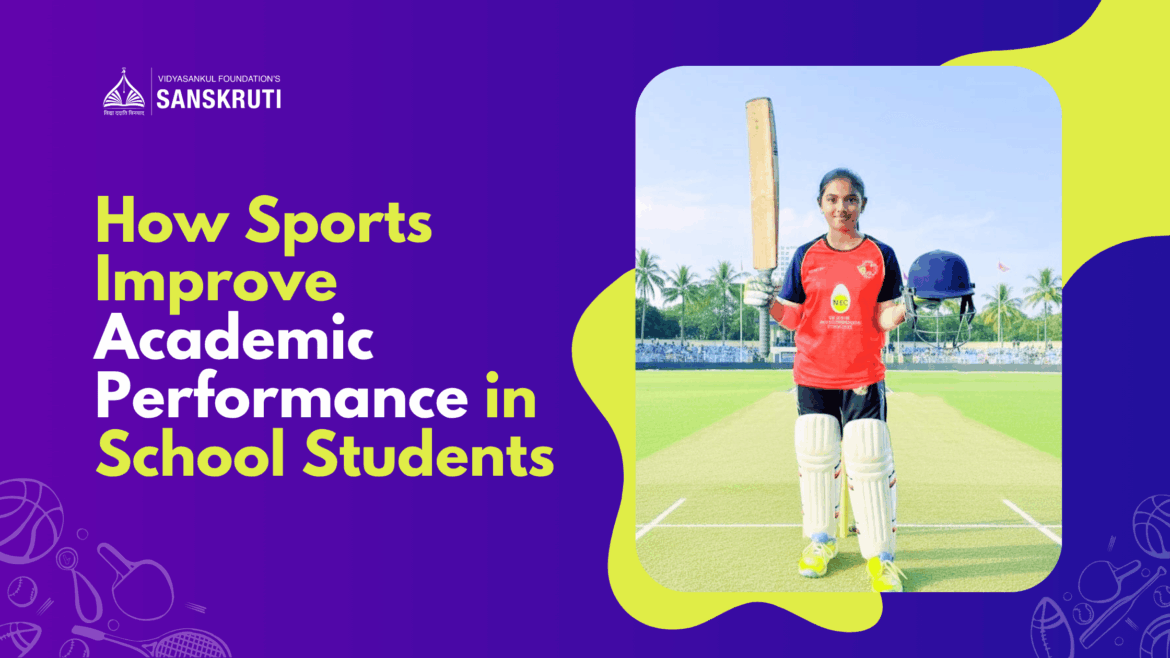
They happen on a cricket ground at 7 in the morning. On a basketball court during lunch break. In the middle of a kabaddi match where your team is down by two points and you’re the last one standing.
Sports are not a break from education. They are education, just in a different uniform.
At Sanskruti World School, the best secondary school in Boisar, we see this play out every single day. Children who are active on the field tend to be sharper and more focused in the classroom. Let’s talk about why.
A Moving Brain Is a Learning Brain
There’s a reason your child seems almost electric with energy after a good game of football, and then, surprisingly, sits down and actually focuses on their homework. That’s not a coincidence. That’s biology.
Physical activity increases blood flow to the brain, which sharpens concentration and memory retention. When children move their bodies, the brain releases chemicals like dopamine and serotonin, the same ones responsible for attention, motivation, and learning.
A study published in the Journal of Sports Sciences found that physical activity interventions positively influenced both cognitive outcomes and academic performance among adolescents and young adults.
Homework at 6 PM? The Sports Kid Gets It Done
Ask any parent of a child involved in sports and they’ll tell you something interesting, these kids somehow manage to get everything done. Practice at 5, dinner at 7, homework by 8, lights out by 10. It sounds impossible, but it works. And it works because sports quietly teach one of the most underrated life skills there is: time management.
When a child knows they have football practice three evenings a week, they stop procrastinating. They learn to use the free hour after school wisely. They start planning ahead for tests because they know Saturday morning belongs to the ground, not the last-minute study panic.
The Exam Season Pressure Valve
Exam season is stressful for everyone! For the child sitting with a mountain of syllabus, for the parent watching anxiously from the kitchen doorway. Anxiety creeps in, sleep gets disrupted, and sometimes the harder a child tries to study, the less they retain.
Sports act like a natural pressure valve in moments like these. Physical activity is one of the most effective ways to reduce cortisol, the body’s stress hormone. A child who plays for even thirty minutes comes back calmer, more emotionally intelligent, and better able to focus on revision.
It’s not about ignoring academics during exams. It’s about keeping the mind healthy enough to actually perform. An active child who has had a chance to breathe, move, and shake off anxiety, that child walks into the exam hall with a clearer head.
The Team That Teaches Communication
There’s something beautiful about watching a group of eight-year-olds figure out how to pass a ball to each other. They’re not just learning to play, they’re learning to trust someone else. To communicate without shouting. To lead when it’s needed and follow when it isn’t.
Team sports build social intelligence in ways that classroom instruction simply can’t replicate. When a child plays on a team, they learn empathy, because they see how it feels when a teammate lets them down, and they understand the weight of letting someone else down too. They learn to speak up, to listen, to read body language, and to resolve conflict quickly, because the game doesn’t wait.
Winning Is Great. Losing Is Better.
Nothing teaches a growth mindset quite like losing a match you really, really wanted to win.
Every child who plays sports will lose at some point. Many times, actually. And in those moments, when the final whistle blows and the scoreboard is not in your favour, something important happens. A child learns that failure is not the end. It’s feedback. It’s information. It’s a reason to come back and try differently.
The most academically resilient students are often the ones who have been knocked down on the field and chose to get back up. They know that a bad test result doesn’t define them, the same way a lost match doesn’t define their ability. They’ve seen themselves improve with effort, and they believe, deeply, that they can improve again.
Give Your Child A Holistic Learning Opportunity
If you’re looking for a school where your child doesn’t have to choose between being an athlete and being a scholar, where both are nurtured, celebrated, and seen as connected, Sanskruti World School is your answer.
As a CBSE school in Boisar, we follow a curriculum that is as rigorous as it is holistic. Our approach to education goes beyond marks and ranks. We believe every child who runs faster, jumps higher, or plays smarter on our grounds is also growing into a more confident, disciplined, and emotionally intelligent learner inside our classrooms.
Because the best version of your child isn’t just the one who scores well on paper. It’s the one who knows how to think under pressure, work with others, bounce back from setbacks, and show up with full energy every single day.
And that child? They’re usually the one who also played outside.
Give your child the education that goes beyond textbooks.
Visit Sanskruti World School, Boisar, and see where sports and academics grow together.
ADMISSIONS OPEN, ENROLL NOW